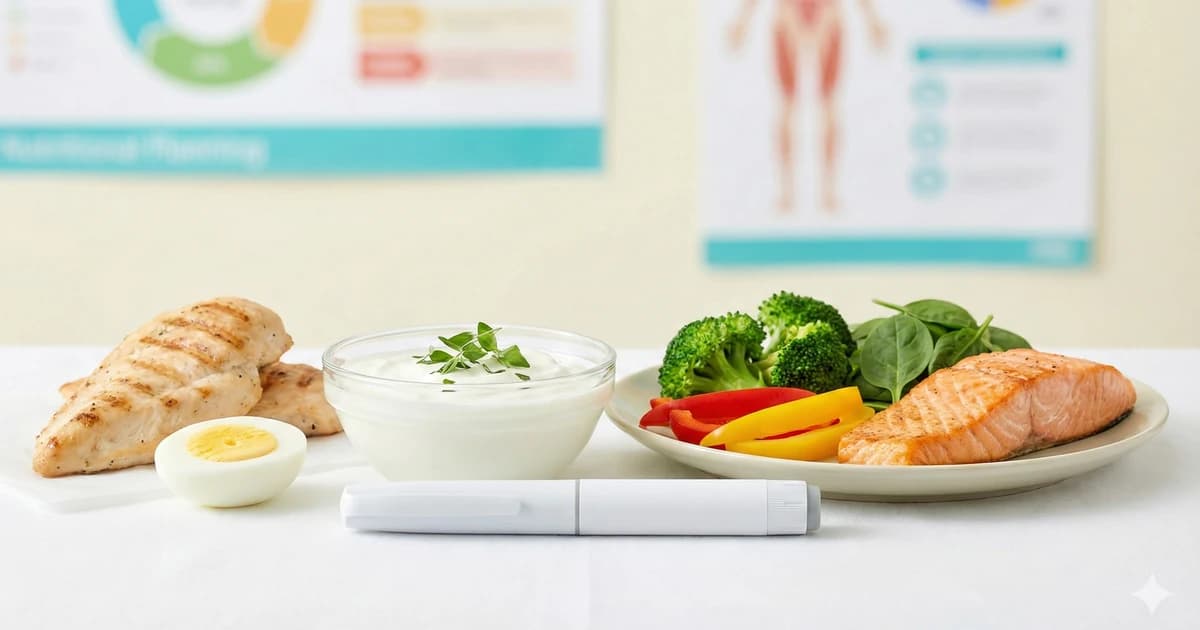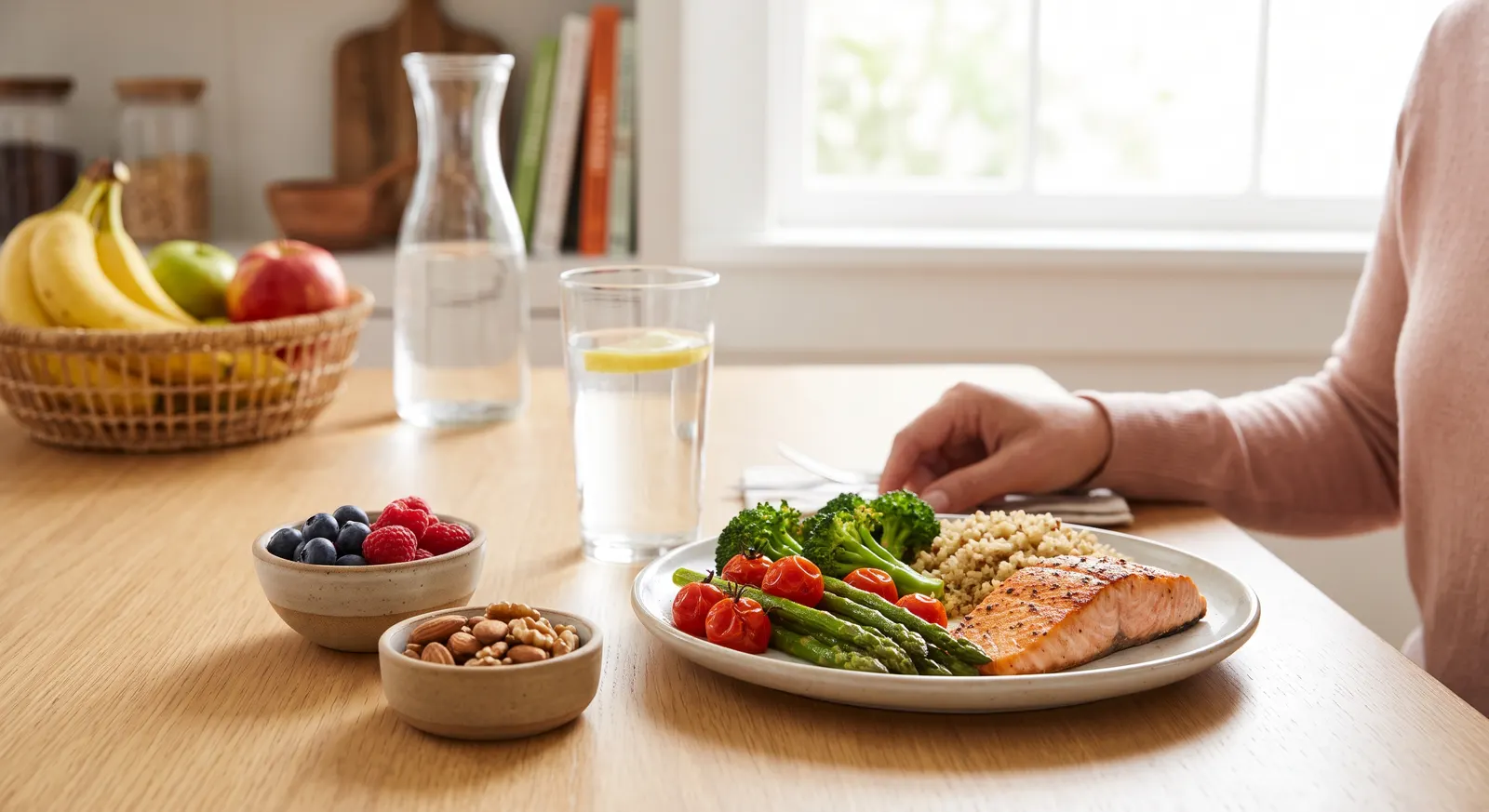

Have you read that Ozempic, Wegovy or Mounjaro "melt away muscle"? The figures in circulation range from 10% to 45% of the weight lost. They rarely describe the same thing. This guide reviews the measurements published between 2021 and 2026, explains what a scanner calls "lean mass" and shows you the two levers that protect your muscles during treatment: protein and strength training.
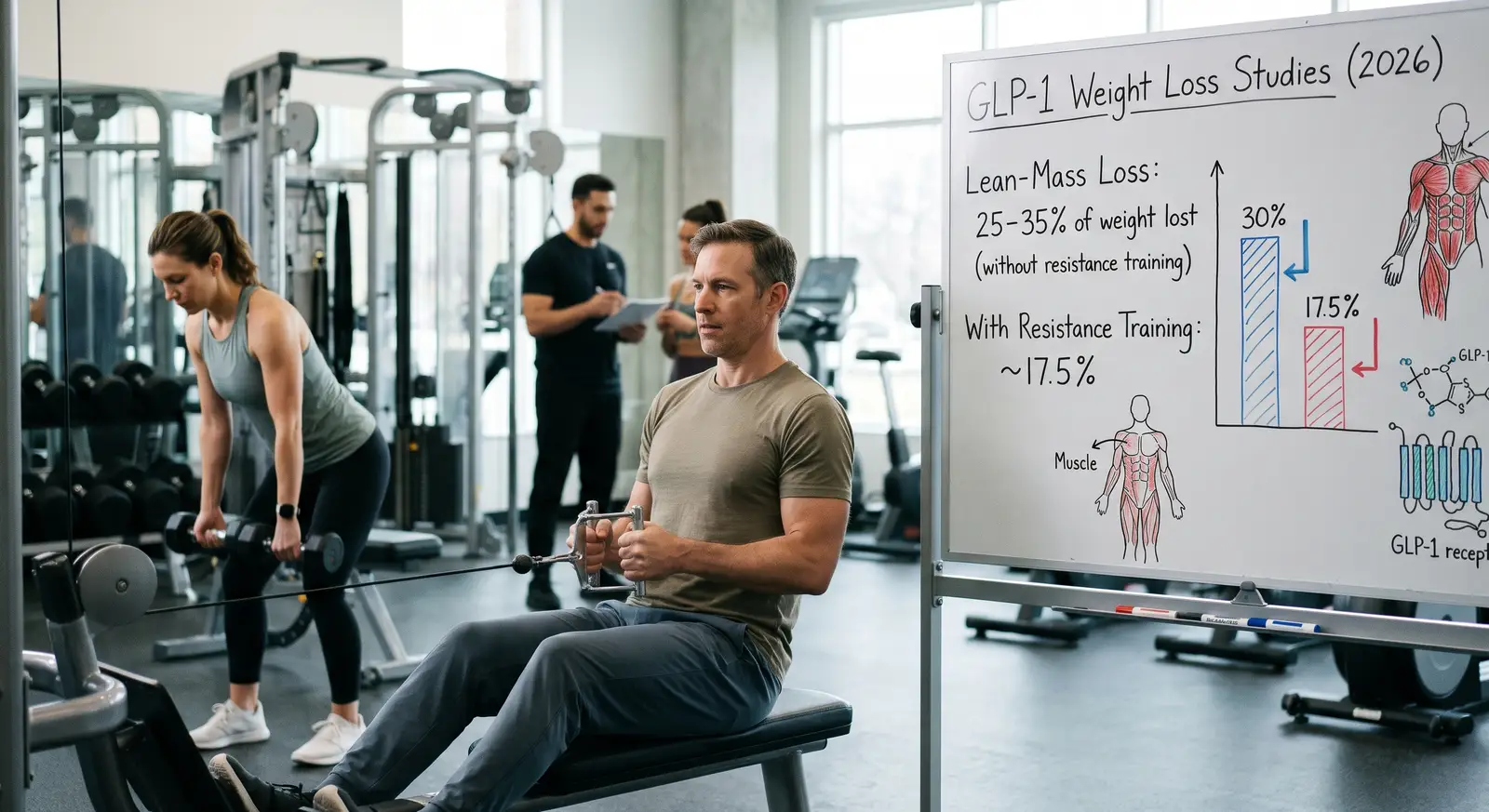
The good news first. In 2026, a meta-analysis of 20 randomised trials compared the share of lean mass in the weight lost on GLP-1 medication and on a lifestyle programme alone. The two approaches give similar proportions. The medication does not destroy muscle in any particular way: it causes a large weight loss, and any large weight loss takes a share of lean tissue with it. The researchers also identified the group that lost the least: the one that added strength training.
For the basics on these medications (mechanisms, effectiveness, side effects), see our complete guide to GLP-1 medications. If you are preparing for the end of treatment, read our article on stopping Ozempic, Wegovy or Mounjaro without regaining weight.
Our promise at Diaeta: personalised nutrition, without hunger, built from foods you find tasty, even when your appetite has shrunk. We work in coordination with your doctor, who remains responsible for your treatment.
Important: this article informs, it does not replace medical advice. If you have kidney disease, ask your doctor what protein intake suits you before increasing it.
1. The Key Facts in 7 Points
- On tirzepatide (Mounjaro), about 75% of the weight lost is fat and 25% lean mass, according to the DXA scan substudy of SURMOUNT-1 (2025). The placebo group showed the same split.
- On semaglutide (Ozempic, Wegovy), the 2026 meta-analysis estimates the lean mass share at 35% on average. The often-quoted figure of 39% comes from a small STEP 1 substudy (140 participants) and sits at the top of the range.
- A lifestyle programme alone causes a comparable share of lean mass loss: 26% on average.
- Adding strength training brings this share down to 17.5%. It is the best-documented lever.
- Protein matters, and many people on GLP-1 medications eat too little of it: about 0.6 g per kilo per day in a real-world study, half the experts' target.
- No trial has yet measured strength or physical function objectively. A French cohort study even observed an increase in grip strength after one year of semaglutide.
- For bones, the data remain thin: no controlled trial has tested bone density on semaglutide 2.4 mg or tirzepatide. Exercise protected bone in the Danish S-LiTE trial.
2. What the Studies Measure
To find out what you lose, researchers use dual-energy X-ray absorptiometry (DXA), a low-dose X-ray scanner. It splits your weight into three compartments: fat, bone and "lean mass", meaning everything else.
2.1 SURMOUNT-1: tirzepatide under the scanner
In SURMOUNT-1, 160 participants had a DXA scan at baseline and after 72 weeks. On tirzepatide, they lost an average of 21.3% of their weight, 33.9% of their fat mass and 10.9% of their lean mass. Relative to the weight lost, that gives about three quarters fat and one quarter lean mass. The authors found this proportion in women, in men and in people over 65, and in the placebo group.
2.2 STEP 1: where the 39% figure comes from
In STEP 1, a substudy of 140 participants measured body composition on semaglutide 2.4 mg over 68 weeks. Lean mass fell by 9.7% and fat mass by 19.3%. Relative to the weight lost, lean mass accounted for almost 40%. This figure made the rounds in the media. Two nuances complete it: the sample was small, and the proportion of lean mass in the body rose by 3 points, because fat fell twice as fast. Body composition therefore improved, even though participants lost lean tissue in kilos.
2.3 The 2026 syntheses
Two reviews published in 2026 offer a wider view.
| Treatment | Share of weight lost as lean mass |
|---|---|
| Semaglutide | 35.2% |
| Tirzepatide | 25.4% |
| Liraglutide | 26.8% |
| Lifestyle alone | 26.2% |
| Lifestyle + strength training | 17.5% |
Source: Eisa et al., Diabetes, Obesity and Metabolism, 2026. Meta-analysis of 20 randomised trials, 15,782 participants, measured by DXA or MRI.
The authors found no significant difference between the medications and lifestyle alone. The Annals of Internal Medicine review (35 trials) arrives at a median of 28.3%, with wide variability from one study to another. It highlights a crucial point: none of these studies measured physical function objectively (strength, walking speed, ability to rise from a chair).
Key insight: the share of lean mass follows the size of the weight loss, whatever the method. The medication makes you lose more weight than a standard programme, so more kilos of lean mass in absolute terms. The proportion stays within the norm for any weight loss.
3. Lean Mass and Muscle: Not the Same Thing
The "lean mass" on a DXA scan includes your muscles, but also your body water, your organs, your skin and the contents of your gut. Bioelectrical impedance measures an even broader "fat-free mass". A 2026 review makes the point: a drop in lean mass does not necessarily mean a loss of strength or physical performance.
Three factors explain part of the drop without touching muscle:
- The liver and other organs shed their excess fat and volume as weight falls.
- Water follows glycogen stores, which shrink when you eat fewer carbohydrates.
- Your body carries less weight: it needs less muscle to move you around. Part of the loss reflects this adaptation.
"Functional" muscle is better measured through strength and mobility. Grip strength (squeezing a dynamometer), the chair-stand test or walking speed say more about your health than kilos of lean mass.
4. Why Your Muscle Still Matters
Putting things in perspective does not mean ignoring them. Your muscle lets you move, store glucose after meals, keep your balance and stay independent as you age. Three situations call for closer attention.
4.1 Sarcopenic obesity
Some people combine excess fat with low muscle mass or strength. In the French SEMALEAN cohort (106 people with an average BMI of 46), 49% had this sarcopenic obesity at baseline. After one year of semaglutide 2.4 mg, lean mass had fallen by about 3 kg at 7 months and then stabilised. Grip strength had increased by 4.5 kg and the share of sarcopenic obesity had dropped to 33%. This study had no control group: it reassures without proving.
4.2 Age
After 60, you rebuild muscle more slowly. Every kilo lost counts for more, and fall prevention becomes a priority. Experts propose higher protein targets for older adults who are losing weight.
4.3 Protein intake that is too low
This is the most common risk and the simplest to correct. In studies, GLP-1 medications reduce spontaneous energy intake by about 40%. When appetite drops, protein often falls by the wayside: it fills you up fast and takes preparation. In a real-world study published in 2025, GLP-1 users consumed about 0.6 g of protein per kilo per day, and 88% stayed below the 0.9 g/kg reference. A large American study found a diagnosis of nutritional deficiency in 22% of new users within the year after starting treatment.
5. Protein: How Much and How
5.1 The target
A framework proposed in 2026 for dietitians recommends at least 1.2 g of protein per kilo per day, up to 1.6 g/kg in adults without kidney disease. The joint advisory from the American societies ACLM, ASN, OMA and TOS (2025) uses the same range, or a practical target of 80 to 120 g per day when the reference weight is uncertain. These targets come from expert opinion and from studies outside GLP-1 treatment: no trial has yet tested a protein dose in people on Ozempic or Mounjaro. They remain the best benchmark available.
The exact figure depends on your weight, your age, your activity, your kidney function and your other health conditions. In obesity, we calculate the target on an adjusted reference weight, not on your current weight.
5.2 Distribution: 20 to 30 g per meal
Your muscle responds better to a well-spread protein dose than to a large intake in the evening. The 2026 framework aims for 0.3 to 0.4 g/kg per meal, or about 20 to 30 g for most adults, with 2.5 to 3 g of leucine (an amino acid abundant in dairy products, meat, fish and soya).
| Food | Portion | Protein (approx.) |
|---|---|---|
| Plain skyr | 150 g | 15 g |
| Eggs | 2 | 12 g |
| Cooked chicken breast | 100 g | 30 g |
| Cooked salmon | 100 g | 24 g |
| Prawns | 100 g | 22 g |
| Firm tofu | 100 g | 13 g |
| Cooked lentils | 150 g | 13 g |
| Emmental | 30 g | 8 g |
| Semi-skimmed milk | 250 ml | 8 g |
5.3 With a small appetite
- Eat the protein portion first. You will finish it before the fullness signal arrives.
- Choose easy textures on nausea days: blended soup with red lentils, skyr and berry smoothie, scrambled eggs, quark or fromage frais custard.
- Add protein to what you already enjoy: feta on salad, roasted chickpeas on soup, ham in an omelette, edamame in a stir-fry.
- Plan a protein snack if your meals stay small: Greek yoghurt, cream cheese, a handful of almonds with a piece of cheese.
- Keep a protein powder in reserve for difficult days. A 2026 review considers it useful when food is not enough. It does not replace meals.
To build complete plates with a small appetite, read our guide what to eat on Ozempic, Wegovy or Mounjaro.
6. Strength Training
Protein supplies the bricks. Strength training gives the order to build. Without that signal, your body burns part of the protein as fuel. A 2022 meta-analysis in healthy adults showed this: extra protein increases lean mass when it accompanies resistance exercise.
In the 2026 meta-analysis, the only group below the 20% mark for lean mass lost combined lifestyle and strength training. The Danish S-LiTE trial provides direct evidence with a GLP-1: after initial weight loss, participants who combined liraglutide with supervised exercise lost the most weight and the most fat mass, and kept their results better after stopping.
6.1 A realistic programme
- Two to three sessions a week, on non-consecutive days. The WHO recommends at least two days of muscle-strengthening activity a week for all adults.
- The major muscle groups: squats or chair stands, push-ups against a wall or worktop, band rows, step-ups, core exercises.
- A load that progresses: when you manage 12 repetitions without difficulty, add a little weight or resistance.
- Walking alongside, for endurance and blood sugar after meals.
If you have never done strength training, a physiotherapist or a qualified coach can teach you the right movements. Start with your body weight: consistency counts more than intensity.
7. What About Your Bones?
Any large weight loss can reduce bone density, because your skeleton carries less load. For GLP-1 medications, a 2026 meta-analysis (12 placebo-controlled trials, mostly with older molecules) found a small drop in density at the lumbar spine, with no change at the hip. It found no controlled trial measuring bone on semaglutide 2.4 mg or tirzepatide. Another 2026 meta-analysis, led by a Belgian team from the universities of Namur and Liège with 60 studies and more than 1.2 million people, found no effect on either bone density or fractures.
In S-LiTE, liraglutide alone reduced bone density at the hip and spine. With exercise, this drop disappeared, despite the largest weight loss. To protect your bones:
- Impact or weight-bearing exercise: brisk walking, climbing stairs, strength training.
- Enough calcium: dairy products, fortified plant-based drinks, calcium-rich mineral waters, calcium-set tofu.
- Adequate vitamin D status, to check with your doctor. In Belgium, many adults run low in winter.
- Protein, which also supports the bone matrix.
Post-menopausal women and older adults deserve particular attention: talk to your doctor about it.
8. Tracking Your Body Composition
The scale tells you how much you lose. It does not tell you what you lose. Useful monitoring combines three measures:
- Body composition analysis at the start of treatment and then about every three months, with the same device and under the same conditions (fasting, empty bladder, same time of day).
- A simple strength test, such as grip strength or the number of chair stands in 30 seconds.
- How you feel: do you climb stairs more easily? Do you carry your shopping without strain?
If lean mass falls faster than expected or your strength declines, we adjust your intake and your activity before the loss sets in.
9. Frequently Asked Questions
Does Ozempic cause muscle loss?
Ozempic causes lean mass loss, like any large weight loss. In studies, it accounts on average for 25 to 35% of the weight lost on semaglutide or tirzepatide, a proportion close to that of a lifestyle programme alone. Protein and strength training reduce this share.
Is the 39% muscle loss figure true?
It comes from a STEP 1 substudy of 140 people and measures lean mass, not muscle alone. The 2026 meta-analysis puts semaglutide at 35% on average and tirzepatide at 25%. The 39% figure therefore sits at the top of the range.
Does Mounjaro cause less muscle loss than Ozempic?
The averages in the 2026 meta-analysis are lower for tirzepatide (25%) than for semaglutide (35%). The trials did not compare the two head to head on this outcome, and the authors did not conclude there was a difference between medications.
How much protein should you eat on GLP-1 medications?
Experts propose at least 1.2 g per kilo per day, up to 1.6 g/kg without kidney disease, spread across meals at about 20 to 30 g each. Your exact need is calculated individually.
Should you take protein or creatine supplements?
A protein powder helps on days when you cannot eat enough. Creatine, leucine and HMB remain add-on options, supported by indirect evidence. Talk to your dietitian or doctor before taking them.
Does the hollowed face ("Ozempic face") come from muscle loss?
It comes mainly from the loss of facial fat that follows rapid weight loss. It does not directly reflect muscle mass.
10. Our Personalised Approach at Diaeta
In Brussels, we support people on GLP-1 medications at every stage of treatment. Protecting muscle starts at the first consultation.
What We Promise You
- Never hungry: meals built for your current appetite, small but complete.
- Foods you love: we add protein to your favourite dishes instead of imposing a menu.
- Evidence-based advice: every target rests on published trials and guidelines.
- A target calculated for you: your protein need takes into account your weight, your age, your kidneys and your activity.
How We Support You
- Body composition analysis at baseline and during follow-up, to check that you are losing fat and keeping your muscle.
- A day-to-day protein plan: meal and snack ideas adapted to your tastes, your budget and any nausea.
- Coordination with your doctor and, if needed, a physiotherapist for the strength programme.
- Regular adjustments at every dose step and every change in appetite.
To find out more, see our GLP-1 support and our weight loss support. If you live with diabetes, visit our diabetes page.
Are you on Ozempic, Wegovy or Mounjaro and want to keep your muscle? Book an appointment for a personalised consultation in Brussels.
Scientific References
- Look M, et al. Body composition changes during weight reduction with tirzepatide in the SURMOUNT-1 study of adults with obesity or overweight. Diabetes Obes Metab. 2025;27(5):2720-2729. doi:10.1111/dom.16275. PMID: 39996356.
- Wilding JPH, Batterham RL, Calanna S, et al. Once-weekly semaglutide in adults with overweight or obesity (STEP 1). N Engl J Med. 2021;384(11):989-1002. doi:10.1056/NEJMoa2032183. PMID: 33567185.
- Eisa N, et al. Lean mass changes with incretin therapy versus lifestyle intervention: a systematic review and meta-analysis of randomised controlled trials. Diabetes Obes Metab. 2026;28(6):4818-4827. doi:10.1111/dom.70666. PMID: 41877354.
- Batsis JA, et al. Effect of incretin-based and nonpharmacologic weight loss on body composition: a systematic review. Ann Intern Med. 2026;179(7):996-1013. doi:10.7326/ANNALS-25-00478. PMID: 41996180.
- Alissou M, et al. Impact of semaglutide on fat mass, lean mass and muscle function in patients with obesity: the SEMALEAN study. Diabetes Obes Metab. 2026;28(1):112-121. doi:10.1111/dom.70141. PMID: 41068996.
- Šantić R, et al. Lean mass and musculoskeletal preservation in GLP-1-based obesity treatment: nutrition, exercise, supplementation, and monitoring strategies. Metabolites. 2026;16(6). doi:10.3390/metabo16060364. PMID: 42346344.
- Arslan S, et al. Medical nutrition in the glucagon-like peptide-1 (GLP-1) era: protein strategies, micronutrient monitoring, and lean mass preservation. Clin Nutr ESPEN. 2026;73:103305. doi:10.1016/j.clnesp.2026.103305. PMID: 42036071.
- Mozaffarian D, et al. Nutritional priorities to support GLP-1 therapy for obesity: a joint Advisory from the American College of Lifestyle Medicine, the American Society for Nutrition, the Obesity Medicine Association, and The Obesity Society. Am J Clin Nutr. 2025;122(1):344-367. doi:10.1016/j.ajcnut.2025.04.023. PMID: 40450457.
- Kerlikowsky, et al. GLP-1 receptor agonists: good for body weight, bad for micronutrient status? Curr Dev Nutr. 2025;9(11):107587. doi:10.1016/j.cdnut.2025.107587. PMID: 41328178.
- Scott Butsch W, et al. Nutritional deficiencies and muscle loss in adults with type 2 diabetes using GLP-1 receptor agonists: a retrospective observational study. Obes Pillars. 2025;15:100186. doi:10.1016/j.obpill.2025.100186. PMID: 40584822.
- Real-world study of protein intake in GLP-1 users. J Int Soc Sports Nutr. 2025. doi:10.1080/15502783.2025.2550139. PMCID: PMC12419545.
- Nunes EA, Colenso-Semple L, McKellar SR, et al. Systematic review and meta-analysis of protein intake to support muscle mass and function in healthy adults. J Cachexia Sarcopenia Muscle. 2022;13(2):795-810. doi:10.1002/jcsm.12922. PMID: 35187864.
- Lundgren JR, Janus C, Jensen SBK, et al. Healthy weight loss maintenance with exercise, liraglutide, or both combined. N Engl J Med. 2021;384(18):1719-1730. doi:10.1056/NEJMoa2028198. PMID: 33951361.
- Lai CH, Li YT, Wu TS, Wu CT. Skeletal effects of GLP-1 receptor agonist therapy in adults with overweight or obesity: a systematic review. Arch Osteoporos. 2026;21(1). doi:10.1007/s11657-026-01785-8. PMID: 42920024.
- Safargar M, et al. The effect of glucagon-like peptide-1 receptor agonists on bone metabolism: a systematic review and meta-analysis of randomized placebo-controlled trials of predominantly first-generation agents. Bone. 2026:118160. doi:10.1016/j.bone.2026.118160. PMID: 42971377.
- Beaudart C, Malréchauffé Y, van Heden S, et al. GLP-1 receptor agonists and musculoskeletal outcomes: a systematic literature review and meta-analysis. Drugs. 2026;86(10):1661-1691. doi:10.1007/s40265-026-02365-3. PMID: 42730869.
- World Health Organization. WHO guidelines on physical activity and sedentary behaviour. Geneva: WHO; 2020.