
In early 2026, the Rome V consensus redrew the map of irritable bowel syndrome. For a decade, the Rome IV criteria excluded millions of people whose symptoms did not fit the right box. The overly strict pain threshold had caused global IBS prevalence to drop from 9.2% to 3.8%. Many patients lived with real bloating, disturbed bowel habits and fatigue, without ever receiving a clear answer.
Rome V corrects this imbalance. The new criteria reintegrate real clinical presentations, restore diagnostic sensitivity to 90.2%, and draw on a decade of discoveries about the gut-brain axis: post-infectious autoimmunity, mucosal immunity, small intestinal bacterial overgrowth. IBS is no longer a diagnosis of exclusion made by default. It is a positive diagnosis, with identifiable mechanisms and precise therapeutic levers.
Our promise at Diaeta: nutritional support grounded in these scientific advances to restore your digestive comfort — without ever leaving you hungry and while keeping foods you find delicious. IBS is manageable, and it is managed on your terms.
1. Rome V: What Changes in IBS Diagnosis
IBS belongs to the family of disorders of gut-brain interaction. The Rome committee revises its criteria every ten years. Rome IV, published in 2016, raised the threshold for abdominal pain to at least one day per week and removed the term "discomfort", considered too imprecise across languages. This choice paid off in specificity — 97.1% — but sacrificed sensitivity.
1.1 The prevalence paradox
By tightening the pain criterion, Rome IV made genuinely ill patients disappear from the statistics. Global IBS prevalence fell from 9.2% (Rome III) to 3.8% (Rome IV). The effect hit Asia hardest, where patients describe their symptoms through bloating and discomfort more than acute pain. In Japan, estimated prevalence dropped from 9.3% to 2.2%. In China, from 7.4% to 2.3%.
1.2 The new Rome V threshold
Rome V relaxes the pain frequency criterion: at least 3 days per month on average, versus at least 1 day per week. Prospective validation trials show this threshold restores sensitivity of 90.2% while maintaining specificity of 85.1%. Global prevalence is expected to rise back towards 9%.
| Criterion | Rome IV (2016) | Rome V (2026) |
|---|---|---|
| Pain frequency | ≥ 1 day / week | ≥ 3 days / month (average) |
| Chronicity | ≥ 6 months | ≥ 6 months (unchanged) |
| Association with defaecation | 2 of 3 criteria | 2 of 3 criteria (unchanged) |
| Global prevalence | 3.8% | ~9% expected |
1.3 Subtypes and continuum with chronic constipation
Rome V retains the four subtypes: IBS-C (constipation), IBS-D (diarrhoea), IBS-M (mixed) and IBS-U (unclassified). The novelty lies in the recognition of fluid transitions between these forms: the same patient may shift from IBS-D to IBS-M over months. The consensus also places IBS-C and chronic constipation on a single spectrum of sensorimotor dysfunction, aligning their management.
1.4 Paediatrics: from age criteria to symptom patterns
Rome V abandons age-based subdivisions in favour of a framework based on symptom patterns by anatomical region. "Infantile colic" becomes "infant distress syndrome". The consensus identifies developmental risk factors: early digestive infections, food allergies, stress, adverse childhood experiences. These interact with vulnerability of the autonomic nervous system.
Key insight: If Rome IV excluded you from diagnosis for insufficient pain frequency, Rome V brings you back within its scope. Your bloating and disturbed bowel habits are recognised as IBS symptoms, not as a complaint without a name.
2. Pathophysiology: Post-Infectious Autoimmunity
Food poisoning can trigger lasting IBS. Approximately 11% of people develop post-infectious IBS after acute bacterial gastroenteritis. Research has elucidated the molecular cascade linking infection to the chronic disorder.
2.1 The molecular mimicry cascade
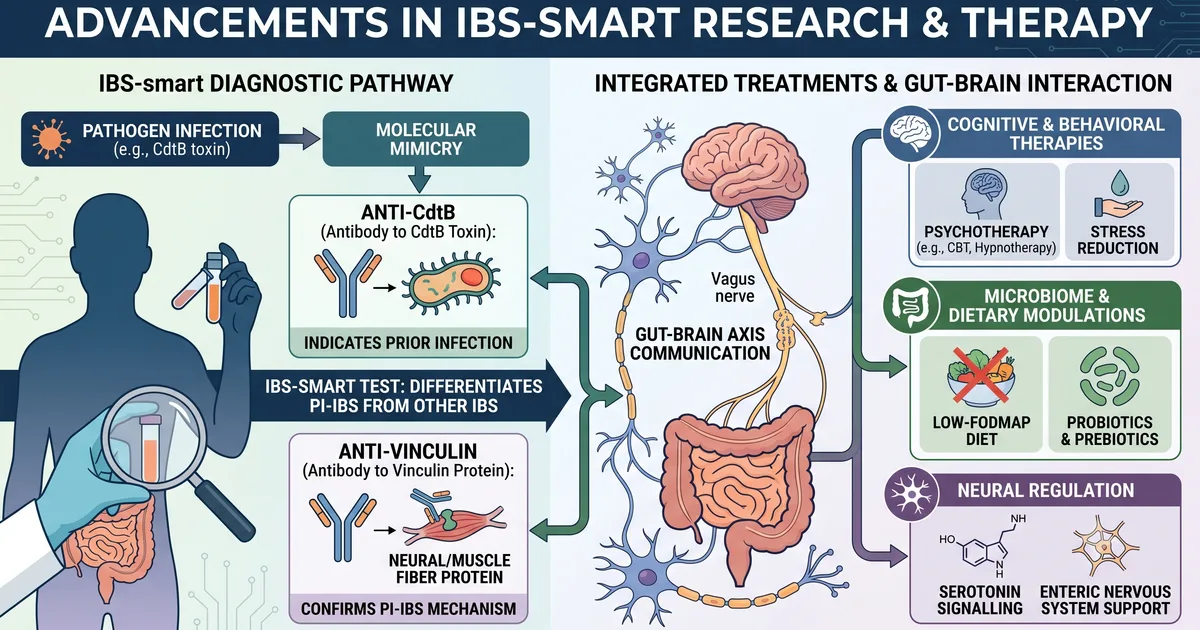
Four pathogenic bacteria play a central role: Campylobacter, Salmonella, E. coli, Shigella and Yersinia. They release a toxin, CdtB (Cytolethal Distending Toxin B). The immune system produces anti-CdtB antibodies to neutralise this toxin.
The problem lies in the structural resemblance between CdtB and vinculin, a cytoskeletal protein present in the enteric nervous system, smooth muscle and interstitial cells of Cajal. These cells orchestrate the migrating motor complex, the "broom" that clears the small intestine between meals. Through cross-reactivity, anti-CdtB antibodies attack vinculin. The autoimmunity damages pacemaker cells, disrupts the migrating motor complex, and promotes luminal stasis, SIBO, gas and visceral pain.
2.2 The second-generation IBS-Smart test
Serology measures two antibodies — anti-CdtB and anti-vinculin — and guides the clinician.
| Serological profile | Specificity / PPV | Interpretation |
|---|---|---|
| Anti-CdtB+ / Anti-vinculin− | 94% / 96% | Recent or past gastroenteritis, high SIBO risk |
| Anti-CdtB− / Anti-vinculin+ | 91% / 96% | Self-sustaining chronic autoimmune state (3 to 4 months to establish) |
| Anti-CdtB+ / Anti-vinculin+ | 100% / 100% | Active high-titre autoimmunity, recent infection, maximum SIBO risk |
| Anti-CdtB− / Anti-vinculin− | Non-indicative | Investigate coeliac disease, bile acid malabsorption, microscopic colitis |
The Wellmark 2026 assessment classifies this serological test as "investigational": no randomised trial proves that screening improves long-term prognosis compared to symptom-based Rome V management. Its utility lies in therapeutic orientation and validation of the patient's experience. Putting a mechanism to symptoms changes the therapeutic relationship.
2.3 Mucosal barrier and low-grade inflammation
Mucosal biopsies by Nicholas Talley identify low-grade inflammation and intestinal hyperpermeability as central drivers. Food allergens and infections create micro-epithelial tears. Antigens cross the barrier, trigger cytokine cascades, recruit mast cells and eosinophils. These cells release histamine and tryptase, which sensitise sub-mucosal nerve endings. The result: visceral hypersensitivity, bloating, hypermotility.
Key insight: If your digestive problems began after food poisoning or gastroenteritis, the post-infectious autoimmune mechanism probably explains your situation. This pathway directly guides the management strategy.
3. Microbiome: The SIBO, IMO, SIFO Spectrum
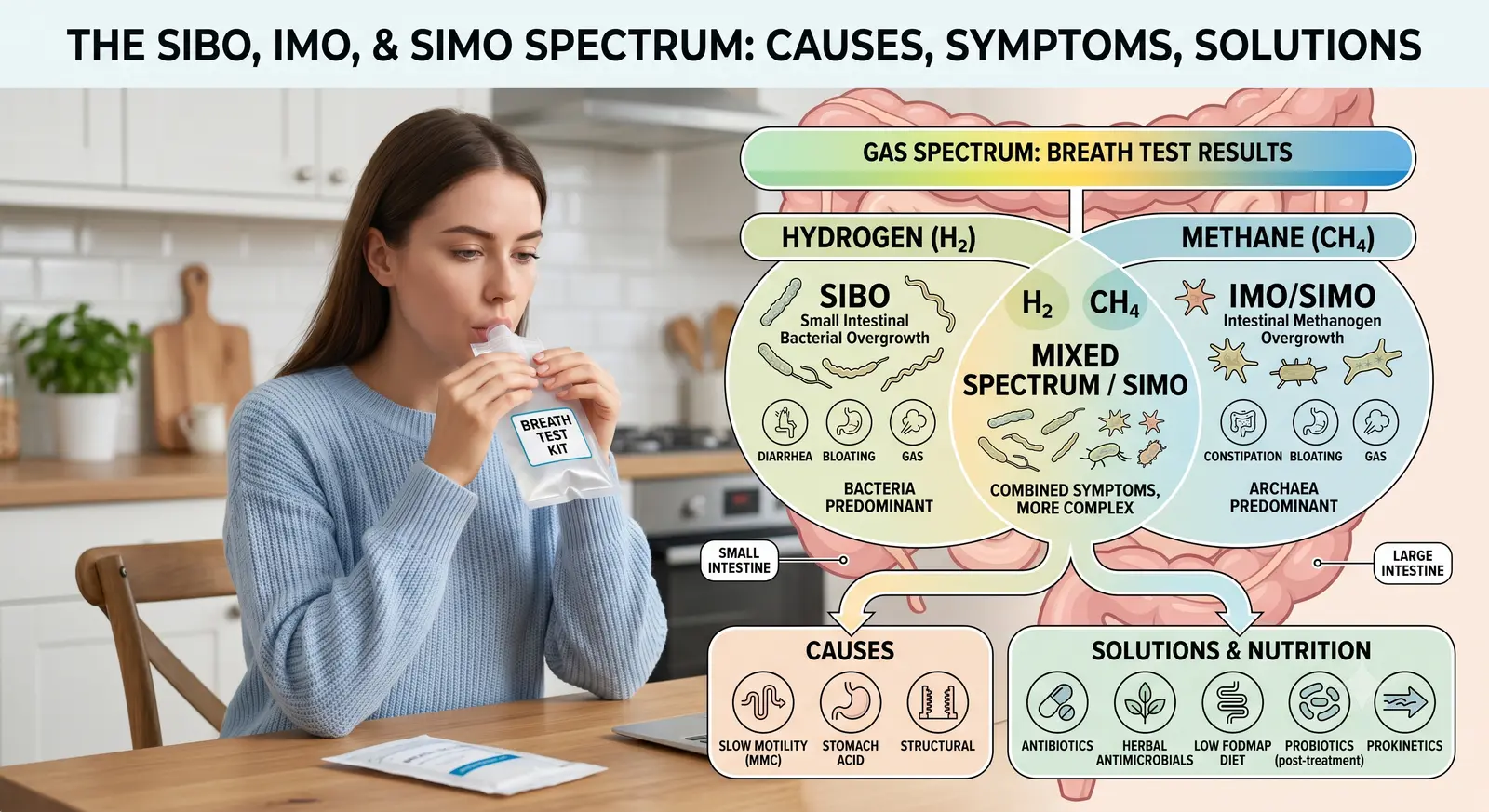
IBS frequently accompanies a microbial imbalance in the small intestine. The umbrella term SIMO groups three distinct forms, each with its organism and clinical profile.
| Form | Organism / gas | Clinical profile |
|---|---|---|
| Hydrogen SIBO | Bacteria, H2 | Rapid carbohydrate fermentation, luminal water retention, diarrhoea, cramps |
| IMO (methanogens) | Methanobrevibacter smithii, CH4 | Methane inhibits cholinergic transmission, severe constipation |
| H2S overproduction | Sulphate-reducing bacteria, H2S | Rapid transit, visceral hypersensitivity, sulphurous gas |
| SIFO (fungal) | Yeasts (Candida) | Symptoms similar to SIBO, undetectable on breath test |
3.1 Consequences of massive overgrowth
A high microbial load depletes the body: vitamin B12 deficiency, carbohydrate malabsorption, micro- or macrocytic anaemia, chronic fatigue, polyneuropathy, concentration difficulties. Your doctor and dietitian look for these signs in your workup.
Key insight: A breath test measuring only hydrogen and methane may miss hydrogen sulphide overproduction or fungal overgrowth. If your symptoms persist despite a "normal" test, the trail remains open.
4. IBS or IBD: A Critical Distinction
IBS and inflammatory bowel diseases (IBD: Crohn's disease, ulcerative colitis) share symptoms but rest on different mechanisms. American Gastroenterological Association guidelines distinguish them clearly.
| Dimension | IBS | IBD |
|---|---|---|
| Microbiome | Luminal dysbiosis, altered SCFAs, H2, CH4 | Reduced alpha diversity, Firmicutes depletion, adherent-invasive E. coli |
| Cellular target | Cajal cells, enteric neurones, sub-mucosal mast cells | Paneth cell dysfunction, intraepithelial lymphocytes |
| Validated approach | Rifaximin + low-FODMAP diet | VSL#3 reserved for pouchitis prevention (ulcerative colitis) |
4.1 Faecal microbiota transplantation
The European SoHO 2024 regulation restricts faecal microbiota transplantation to recurrent Clostridioides difficile infections. OpenBiome suspended general distribution at the end of 2024 under FDA requirements. Faecal transplantation is therefore not a routine option for IBS.
5. 2026 Medical Treatments
Medical treatments fall within your doctor's remit. Understanding how they work helps you engage with your clinician and coordinate your nutritional management.
5.1 Linaclotide (Linzess/Constella) for IBS-C
Linaclotide is a 14-amino-acid peptide, a GC-C receptor agonist on the luminal membrane of enterocytes. It stimulates intracellular cGMP, activates the CFTR channel, induces chloride and bicarbonate secretion, and water follows by osmosis. Transit accelerates. Extracellular cGMP also suppresses afferent visceral nociceptors, providing lasting pain relief.
2024 data show that 34% of IBS-C patients meet the FDA response criteria (≥30% pain reduction and at least 3 additional complete spontaneous bowel movements per week), versus 14% on placebo. Maximum abdominal pain decreases by an average of 45% at week twelve. Dosage: 290 µg per day, 30 minutes before the first meal. Severe diarrhoea in approximately 2%. Approved in children aged 6 to 17 for functional constipation; contraindicated under 6 years (risk of severe dehydration).
5.2 Tenapanor (Ibsrela) for refractory IBS-C
Tenapanor inaugurates a new class: inhibition of the sodium-hydrogen exchanger NHE3. It blocks apical sodium absorption, retains sodium in the lumen, draws in water, increases fluid volume and stimulates peristalsis. By modifying luminal pH, it promotes mucosal healing and stabilises tight junctions, reducing low-grade inflammation and visceral pain.
The TANDEM trials show lasting improvement in stool frequency and abdominal pain. Dosage: 50 mg twice daily, just before breakfast and dinner. Approved in adults with IBS-C refractory to laxatives and fibre. Contraindicated under 6 years; to be avoided from 6 to 17 years.
5.3 Hyoscyamine (IBStat) for acute pain
Hyoscyamine is a fast-acting liquid antispasmodic, suited to acute pain crises in IBS-D and IBS-M. The liquid is rapidly absorbed through the buccal and gastric mucosa. It is a competitive antagonist of M3 muscarinic receptors, blocking smooth muscle spasm and reducing cramps within 30 minutes. Individualised on-demand dosing, in drops or sublingual solution. Caution with anticholinergic effects: risk of heat stroke, acute angle-closure glaucoma.
5.4 Reference agents
- PEG 3350: 17 g once daily, first-line osmotic laxative for constipation
- Prucalopride: 2 mg once daily, 5-HT4 agonist, for refractory chronic constipation
Key insight: None of these medications replace the nutritional approach. They work better when your diet supports your transit and comfort. Doctor and dietitian work together.
6. Nutrition: FODMAP, Fibre and PHGG
Diet remains the most powerful and lasting lever in IBS. Conducted properly, it deprives you of nothing: it identifies your triggers and rebuilds a varied, enjoyable plate.
6.1 The three-phase FODMAP approach
The low-FODMAP diet unfolds in three stages — never as permanent elimination.
- Reduction phase (2 to 6 weeks): temporary reduction in fermentable carbohydrates to calm symptoms
- Structured reintroduction phase: methodical testing by FODMAP group to identify your precise triggers
- Personalisation phase: an expanded, liberalised plan tailored to your individual tolerance
Prolonged strict elimination markedly reduces protective Bifidobacterium. The reintroduction phase is not optional: it protects your microbiome and quality of life.
6.2 Soluble fibre, not insoluble
Aim for 20 to 30 g of soluble fibre per day. Psyllium (ispaghula) binds water and improves stool consistency in both IBS-C and IBS-D. Insoluble fibres such as wheat bran ferment rapidly and irregularly: they worsen gas, bloating and pain. A critical distinction that many generic recommendations overlook.
6.3 Partially hydrolysed guar gum (PHGG)
PHGG at 6 g per day for 12 weeks significantly improves bloating and flatulence compared to placebo. The benefit persists up to 4 weeks after stopping. This gentle prebiotic fibre suits sensitive intestines that tolerate other fibres poorly.
Key insight: The distinction between soluble and insoluble fibre changes everything. Increasing "fibre" without this nuance can worsen your symptoms. Psyllium and PHGG soothe; wheat bran can irritate.
7. Probiotics: Strains with Evidence
A probiotic acts only at the strain, dose and indication studied. Random selection leads to failure. The following strains have solid clinical data in IBS.
| Strain | Indication | Dose and duration |
|---|---|---|
| Bifidobacterium longum 35624 | IBS-D / IBS-M | 109–1010 cells/day, 4 to 8 weeks |
| Lactobacillus rhamnosus GG | Children and adults | 6×10⁹–4×10¹⁰ cells/day |
| Lactiplantibacillus plantarum 299v | Visceral pain, flatulence | 1010–5×10¹⁰ cells/day |
| Saccharomyces cerevisiae CNCM I-3856 | IBS-C, bloating | 4×10⁹–8×10⁹ cells/day, 8 to 12 weeks |
| Bacillus coagulans IS2 | Children and adults (pain, quality of life) | 2×10⁹ cells/day, 8 weeks |
| Bacillus coagulans MTCC5856 | Global IBS-D | 2×10⁹ cells/day, 90 days |
Meta-analyses confirm that B. longum 35624 improves pain, bloating and global scores. L. plantarum 299v reduces flatulence, pain and colonic distension. S. cerevisiae CNCM I-3856 exerts a local analgesic effect. A Swedish double-blind trial (NCT07584278, n=252, Rome V criteria, IBS-SSS ≥75, 12 weeks) has been under way since April 2026 and will further refine these recommendations.
Key insight: "Taking probiotics" means nothing without specifying the strain. The same species may help one patient and have no effect on another. Selection is based on your IBS subtype and dominant symptom.
8. Gut-Brain Axis Therapies
IBS is a disorder of gut-brain interaction. Acting on the brain genuinely modifies the gut. These approaches do not claim "it's all in your head": they target a measurable neurobiological circuit.
8.1 Cognitive behavioural therapy (CBT)
Meta-analyses place the odds of symptom persistence at around 0.6 compared to usual care. CBT delivers lasting improvements in severity and quality of life. It acts on visceral hypervigilance and stress reactions that perpetuate symptoms.
8.2 Gut-directed hypnotherapy
Gut-directed hypnotherapy achieves 70 to 80% responders in refractory IBS, with benefits lasting years after treatment. It normalises colonic motility and attenuates central processing of sensory signals. One of the best-validated interventions for resistant forms.
8.3 Digital therapeutics
Software programmes (Regulora, Zemedy) deliver CBT and hypnotherapy remotely. They widen access, without erasing the disparities affecting low-income, rural or minority populations. A complementary tool, not a substitute for human support.
8.4 Non-invasive vagal stimulation
Vagus nerve stimulation activates the anti-inflammatory cholinergic pathway via the α7 nicotinic receptor. It curbs TNF-α and IL-6 production, attenuates visceral hypersensitivity, stimulates colonic motility and promotes Bifidobacterium and Blautia. An emerging avenue directly linking the nervous system, inflammation and microbiome.
Key insight: The gut-brain axis is not a metaphor. Gut-directed hypnotherapy produces measurable changes in colonic motility. IBS treatment addresses body and nervous system together.
9. A Structured Care Pathway
Rome V enables a clear diagnostic and therapeutic pathway, from positive diagnosis to targeted treatment.
- Positive Rome V diagnosis: pain at least 3 days per month, absence of alarm features
- IBS-D or IBS-M: IBS-Smart serology (anti-CdtB, anti-vinculin). Positive result confirms post-infectious IBS and directs towards SIBO treatment (rifaximin, PHGG). Negative result prompts investigation for bile acid malabsorption, coeliac disease, microscopic colitis
- IBS-C: first-line PEG or prucalopride. If unsuccessful, linaclotide 290 µg/day or tenapanor 50 mg twice daily
- For all subtypes: soluble fibre (PHGG, psyllium), probiotics matched to subtype, gut-directed hypnotherapy or digital therapeutic
9.1 Remote monitoring
Digital monitoring of IBS is developing rapidly. Platforms combine remote symptom tracking with hybrid digital and in-person support. This trend sustains long-term management without replacing the relationship with your clinician.
10. Our Personalised Approach at Diaeta
At Diaeta, we treat IBS for what it is: a real, measurable disorder that responds to a tailored strategy. Rome V criteria recognise you. Our support restores your comfort, meal by meal.
What We Promise You
- Never hungry: even during the FODMAP reduction phase, your meals satisfy. We build complete menus, not lists of prohibited foods
- No unnecessary elimination: every adaptation is targeted and temporary. The reintroduction phase protects your microbiome and your enjoyment of eating
- Evidence-based guidance: we apply Rome V criteria and 2026 data, not dietary trends
- Personalised strategies: your IBS subtype, your triggers and your microbiome guide every recommendation
How We Support You
- Comprehensive assessment: analysis of your symptoms, subtype, infectious history and test results
- Three-phase FODMAP protocol: reduction, methodical reintroduction, personalisation — led by a Monash-certified specialist
- Targeted fibre and probiotic selection: psyllium, PHGG and strains matched to your profile
- Medical coordination: alignment of nutrition with your doctor's treatment and hypnotherapy where needed
Outcomes Observed
With our personalised approach, patients typically report:
- Lasting reduction in bloating and pain through identification of their real triggers
- Regulated bowel habits through a strategy matched to their subtype
- Return of enjoyment in eating without fear of the next meal
You are living with chronic digestive symptoms and want management grounded in Rome V criteria? Book a personalised consultation in Brussels. Together, we will build your tailored nutritional plan.
Scientific References
- Drossman DA, Hasler WL. Rome IV Functional GI Disorders: Disorders of Gut-Brain Interaction. Gastroenterology. 2016;150(6):1257-1261.
- Sperber AD, Bangdiwala SI, Drossman DA, et al. Worldwide Prevalence and Burden of Functional Gastrointestinal Disorders. Gastroenterology. 2021;160(1):99-114.
- Pimentel M, Morales W, Rezaie A, et al. Development and Validation of a Biomarker for Diarrhea-Predominant Irritable Bowel Syndrome in Human Subjects. PLoS One. 2015;10(5):e0126438.
- Talley NJ, Walker MM, Holtmann G. Functional dyspepsia and the gut-brain axis: low-grade duodenal inflammation. Lancet Gastroenterol Hepatol. 2018;3(4):252-262.
- Pimentel M, Saad RJ, Long MD, Rao SSC. ACG Clinical Guideline: Small Intestinal Bacterial Overgrowth. Am J Gastroenterol. 2020;115(2):165-178.
- Singer-Englar T, Rezaie A, Pimentel M. Competitive hydrogen and methane utilization by gut microorganisms. Dig Dis Sci. 2023;68:263-272.
- Lacy BE, Pimentel M, Brenner DM, et al. ACG Clinical Guideline: Management of Irritable Bowel Syndrome. Am J Gastroenterol. 2021;116(1):17-44.
- Chey WD, Lembo AJ, Rosenbaum DP. Efficacy of Tenapanor in Treating Patients With Constipation-Predominant IBS: TANDEM Trials. Am J Gastroenterol. 2020;115(2):281-293.
- Rao SSC, Quigley EMM, Shiff SJ, et al. Effect of Linaclotide on Severe Abdominal Pain in Patients With IBS-C. Clin Gastroenterol Hepatol. 2014;12(4):616-623.
- Halmos EP, Power VA, Shepherd SJ, et al. A diet low in FODMAPs reduces symptoms of irritable bowel syndrome. Gastroenterology. 2014;146(1):67-75.
- Niv E, Halak A, Tiommny E, et al. Randomized clinical study: partially hydrolyzed guar gum (PHGG) versus placebo in IBS. Nutr Metab. 2016;13:10.
- Whorwell PJ, Altringer L, Morel J, et al. Efficacy of an encapsulated probiotic Bifidobacterium infantis 35624 in women with IBS. Am J Gastroenterol. 2006;101(7):1581-1590.
- Ducrotté P, Sawant P, Jayanthi V. Clinical trial: Lactobacillus plantarum 299v in irritable bowel syndrome. World J Gastroenterol. 2012;18(30):4012-4018.
- Ford AC, Lacy BE, Harris LA, et al. Effect of Antidepressants and Psychological Therapies in IBS: Systematic Review and Meta-analysis. Am J Gastroenterol. 2019;114(1):21-39.
- Peters SL, Yao CK, Philpott H, et al. Gut-directed hypnotherapy and the low FODMAP diet in IBS. Aliment Pharmacol Ther. 2016;44(5):447-459.